Why Architects Bring Us In Early
Working with professional partners
There is a moment in most residential projects where the design is finalised, the drawings are issued for tender, and the contractors are asked to price. It is the conventional sequence, and for straightforward builds it works well enough.
For the projects we specialise in, the one-off bespoke homes across south Wiltshire and the surrounding area, that sequence often leaves value on the table. Not because the design is wrong, but because the conversations that would have made it sharper, faster, or more cost-effective never happened. By the time we price the work, the opportunity to influence it has passed.
This is a piece about the alternative. Why the architects we work with most often bring us in early, what that involvement actually looks like, and what it delivers for the project, the client, and ultimately for the architects themselves.
What early involvement means in practice
Early involvement does not mean we turn up at concept stage and redraw the scheme. The design belongs to the architect, and it should. Our role is different.
We come in to look at the drawings with a practical eye. We walk through the buildability of the detail. We flag anything that might cause difficulty on site, whether that is a junction that will be hard to execute cleanly, a sequence that will slow the programme, or a specification that will drive cost without adding proportionate value. Where we see a refinement that genuinely helps, we suggest it. Where the design is right as drawn, we price it and get on with the job of delivering it properly.
The conversation is collaborative, not adversarial. The best architects we work with find it useful precisely because it sharpens their thinking before the scheme is committed, rather than forcing compromises during the build.
The cost argument
A problem spotted on a drawing is far cheaper to solve than a problem uncovered on site. That is the simplest version of the case, and in our experience it is the one that lands hardest with clients when their architect explains it to them.
Variations during construction are expensive. They cost in labour, in materials, in programme delays, and in the compound effect those things have on the rest of the build. They also erode the trust between client and contractor, because every variation conversation starts with a cost and ends with someone paying for it.
A thorough pricing exercise at design stage, carried out by a contractor who has genuinely engaged with the drawings, delivers something valuable: a realistic figure the client can commit to, with a clear understanding of what is included, what is not, and where the risks sit. Transparent, line-by-line pricing sits at the centre of how we work. We go through the numbers carefully, so there are no unpleasant discoveries once work is underway. That protects the client's budget, and it protects the architect's reputation too.
The programme argument
Programme discipline on a bespoke residential build is hard to achieve retrospectively. Once the critical path is disrupted, the knock-on effects are rarely recoverable without cost.
Early contractor involvement lets us shape the programme around the realities of the site, the supply chain, and the sequencing the design requires. Long-lead items can be identified and ordered in good time. Specialist trades can be booked before their diaries close. The handoffs between stages can be planned so that each trade finishes ready for the next to begin, rather than leaving the site waiting.
When we arrive at the start date, the project is set up to run. That is not an accident, and it is not the default outcome of a tender-and-start approach. It is the product of planning that began weeks or months before the first delivery arrived on site.
The buildability conversation
There are details that look elegant on a drawing and prove punishing on site. There are also details that look straightforward and hide real complexity. A contractor with residential experience across south Wiltshire can tell the difference at a glance, and can have a useful conversation about both.
Buildability is not about simplifying designs to suit contractors who would rather do less work. It is about making sure the design can be executed to the standard the architect intends. Sometimes that means suggesting a refinement that delivers the same visual outcome with a more reliable detail. Sometimes it means flagging that a particular junction needs a specialist, or a longer programme window, or a specific sequence to come out correctly. Sometimes it means confirming that the design as drawn is the right answer and we will build it exactly that way.
The point of the conversation is to surface those distinctions before they become problems. Architects who have worked with us know we will not use buildability discussions as cover for cost-cutting or corner-cutting. We work through the detail because that is where the quality is.
Farley: what early involvement can deliver
One recent project in Farley, Wiltshire, illustrates the argument better than any abstract case for it.
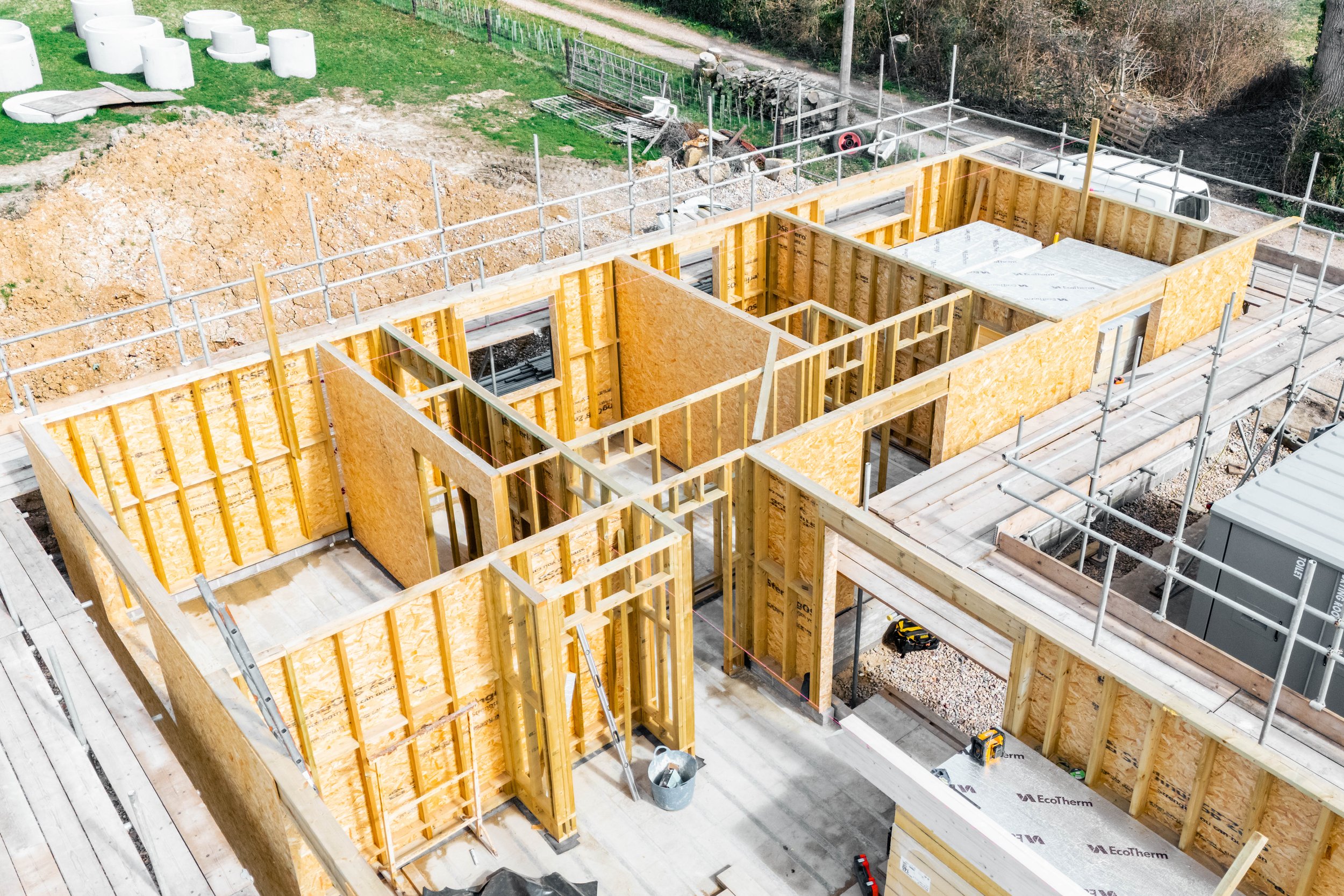
The client wanted a contemporary barn with a full basement level on a modest budget. The decision to extend downwards was technically demanding and required careful thinking from the very beginning of the project to ensure it could be delivered properly. Brought in at the design stage, we worked through the buildability of the basement with the design team, shaped the programme around its sequencing, and priced the scheme thoroughly before it was committed.
The outcome is a striking, considered home that punches well above its budget. That result did not happen because the design was less ambitious than it could have been, it happened because the builder was in the room when the decisions were being made. The kind of collaboration that only delivers its full value when it starts early enough to matter.
What we bring to the conversation
A few things are worth saying plainly about how we work with architects, because they are the things our professional partners most often mention.
Our sites are well-run. We have been told by architects we have worked alongside that our sites are amongst the tidiest and best-organised they have come across. That matters to you because it signals how the job is being managed overall, and because your client visits regularly and forms impressions that come back to you.
Our attention to structural detail is strong. That is not our phrase, it is theirs. We work through the detail because that is where the quality is, and because we know that is what you need from a contractor.
Every client has a named project administrator from day one. Your client is not chasing a site team for updates, and you are not either. Communication is structured, documented, and clear.
Our relationship with your client does not end at handover. We carry out an internal defect rectification review before sign-off, and we return at twelve and twenty-four weeks to check the work and address anything the client has raised. You do not inherit a complaint six months later that we should have handled.
When to bring us in
There is no single right moment. Some architects contact us at concept stage to walk through a site together and talk about what is possible. Others bring us in once the design is developed but before it is issued for tender, so we can work through buildability and pricing in parallel with the final design decisions. A few projects reach us at tender stage with the design fully resolved, and we price them properly and deliver them properly from there.
The earlier the conversation starts, the more value we can add. Even a short call at concept stage, before the design has hardened around a particular approach, can shape the project in ways that pay back many times over across the life of the build.
Ready to talk about a project?
If you have a residential project in development somewhere in south Wiltshire and would like to talk through how we might support it, we would be glad to hear from you. Whether you are at concept stage, ready for tender, or somewhere in between, we will take the time to understand what the project needs.
Call the office on 01725 557591 or drop us an email at office@jamesburtonconstruction.co.uk. If you would rather see the work first, we are happy to send our portfolio across.
Find our more about our work with architects and professional partners here.